Choosing the right online learning platform can feel confusing especially when both Coursera and edX offer university-level courses and professional certifications. 🎓
If you’re serious about upgrading your skills, switching careers, or adding value to your resume, this decision matters more than you think. Both platforms promise high-quality education, but they differ in pricing, learning style, certifications, and overall career impact.
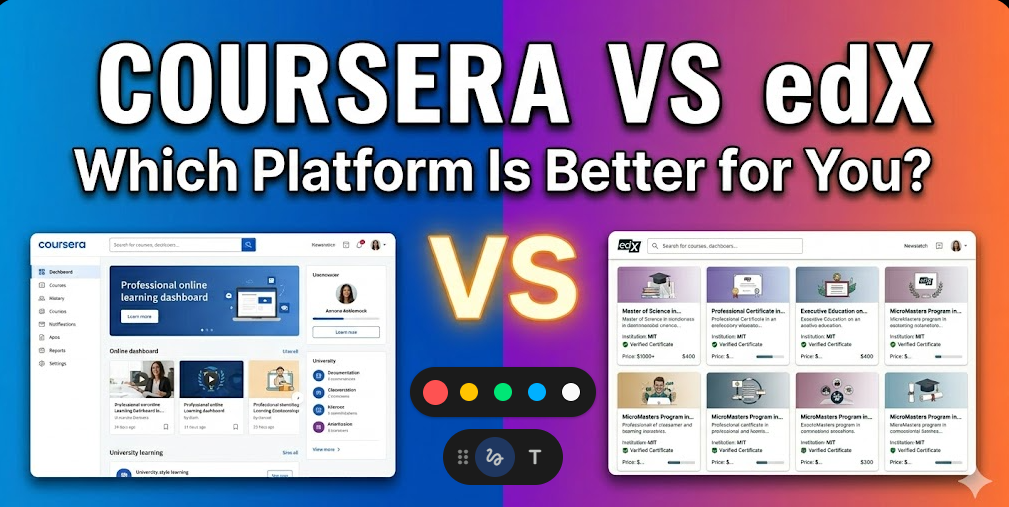
So the real question is:
👉 Which one actually delivers better results for your goals?
In this guide, we’ll break down the key differences between Coursera and edX in a simple way so you can confidently choose the platform that fits your learning style, budget, and career plans. 🚀
⚡ Quick Comparison: Coursera vs edX
| Feature | Coursera | edX |
|---|---|---|
| Founded by | Stanford professors | Harvard & MIT |
| Business model | Public company (for-profit) | Former nonprofit, now part of 2U (for-profit) |
| Number of learners | 140M+ | 48M+ |
| University partners | 300+ (including Yale, Google, IBM) | 160+ (Harvard, MIT, Berkeley, Microsoft) |
| Free access | Audit most courses for free | Audit most courses for free |
| Certificate cost | $49–$79 per course | $50–$300 per course (higher on average) |
| Subscription | Coursera Plus: $59/month or $399/year | edX doesn’t have a true all-you-can-learn subscription |
| Degrees | 40+ online degrees | 200+ online degrees (more options) |
| Micro-credentials | Specializations, Professional Certificates | MicroMasters, Professional Certificates |
| Best for | Career-focused learners, job changers | Academic rigor, degree seekers, advanced learners |
Key takeaway: Coursera is more polished for career impact and subscriptions. edX offers deeper academic content and more degree options, but at a higher per-certificate price. 🎯
🎓 What Is Coursera? (Overview + Best Use Cases)
Coursera was launched in 2012 by Andrew Ng and Daphne Koller, two Stanford computer science professors. Their vision: bring the world’s best education to anyone, anywhere. Today, Coursera is a publicly traded company (NYSE: COUR) with over 7,000 courses, 40+ degrees, and partnerships with top universities like Stanford, Yale, Princeton, as well as industry giants like Google, Meta, and IBM. 🏛️
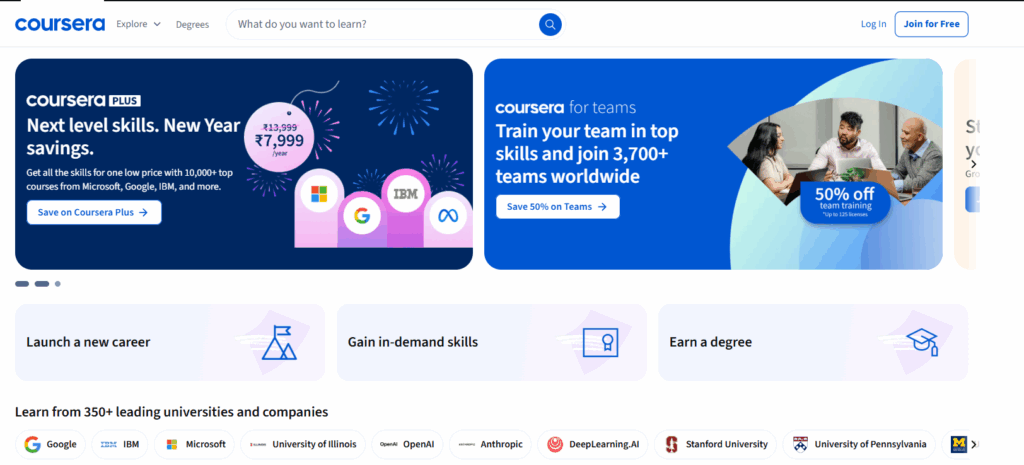
How it works:
You can audit thousands of courses for free. To get a certificate, you pay per course (typically $49–$79) or subscribe to Coursera Plus ($59/month). Courses include video lectures, graded quizzes, peer-reviewed assignments, and often a final project.
Best use cases for Coursera:
- 👨💼 Career changers – Google IT Support, Meta Front-End Developer, etc.
- 🎓 College students – supplementing their degree with elite content.
- 💼 Working professionals – earning promotions with verifiable certificates.
- 🏢 Corporate teams – using Coursera for Business.
- 🌍 Anyone who wants a recognized credential without paying degree prices.
🏫 What Is edX? (Overview + Best Use Cases)
edX was founded in 2012 by Harvard University and MIT as a nonprofit alternative to Coursera. Its mission was purely academic: provide free, high-quality courses from the world’s best universities. In 2021, edX was sold to 2U, a for-profit education technology company, but the platform still maintains strong ties to its founding universities. 🎓
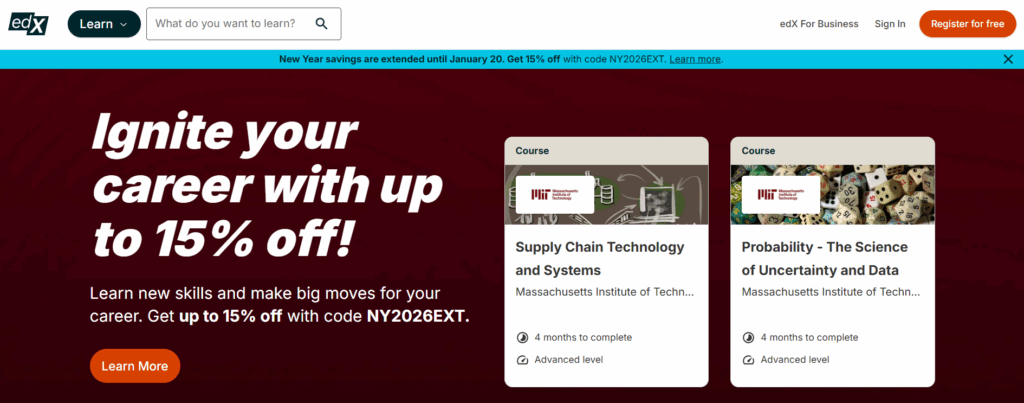
How it works:
Like Coursera, edX allows free auditing of most courses. Certificates cost more than Coursera – typically $50 to $300 per course. edX does not have a single subscription that covers all courses; instead, you pay per certificate or buy programs. They offer MicroMasters (graduate-level series) and Professional Certificates.
Best use cases for edX:
- 🧠 Academically ambitious learners – want rigorous, university-style content.
- 🎓 Degree seekers – edX has over 200 online degrees (more than Coursera).
- 📚 Advanced students – MicroMasters can count toward full master’s degrees.
- 🏛️ Fans of Harvard/MIT/Berkeley – specific prestige.
- 💰 Financial aid seekers – edX offers generous aid (more on that later).
💰 Pricing Comparison: Coursera vs edX (Free Courses, Certificates & Value)
This is where the platforms differ significantly. Let’s break down real numbers. 💵
Coursera Pricing:
- Free audit: Yes, for 95%+ of courses (no certificate, no graded assignments).
- Per course certificate: $49 – $79 (one-time).
- Specialization (series of 3–7 courses): $49 – $79 per month (takes 3–6 months).
- Coursera Plus: $59/month or $399/year – unlimited certificates for 7,000+ courses.
- Degrees: $9,000 – $45,000 total.

edX Pricing:
- Free audit: Yes, for almost all courses (no certificate, sometimes limited time).
- Per course certificate: $50 – $300 (most are $150–$250). Significantly higher than Coursera.
- MicroMasters: $500 – $1,500 per program (usually 3–5 courses).
- Professional Certificate: $150 – $800 per program.
- Degrees: $10,000 – $60,000 total (more expensive on average).
- No all-access subscription – you pay per program or certificate.
Value verdict:
- For a single certificate → Coursera wins (cheaper).
- For unlimited learning → Coursera Plus is unbeatable ($399/year).
- For a MicroMasters that can transfer to a degree → edX has a unique advantage.
- For free auditing → Tie (both excellent).
🧑🏫 Course Quality & University Partnerships (Which One Is More Credible?)
Both platforms host elite universities, but there are nuances. 🎓
Coursera’s partners:
300+ including Stanford, Yale, Princeton, University of Michigan, Penn, as well as industry partners like Google, IBM, Meta, Salesforce, Intuit. This mix of academic and corporate content makes Coursera very practical.
edX’s partners:
160+ including Harvard, MIT, UC Berkeley, Dartmouth, Columbia, University of Texas, Microsoft, AWS. edX is stronger on the pure academic side – their courses often feel more like real university classes (harder, longer, more theoretical).
Quality comparison:
- Both are high-quality, but edX courses tend to be more rigorous (more readings, longer videos, tougher exams).
- Coursera courses are more polished (better production, shorter videos, more interactive quizzes).
- For cutting-edge tech (AI, data science), both are excellent.
- For humanities and social sciences, edX (Harvard/MIT) has an edge.
Winner: Tie for quality, but edX for pure academic rigor; Coursera for production value and career focus. 🏆
📜 Certificates & Recognition (Which Platform Has More Value?)
Does a Coursera certificate carry the same weight as an edX certificate? Let’s be honest. 🧾
Coursera certificates:
- Recognized by thousands of employers (Google, Walmart, Deloitte, Accenture).
- Can be added to LinkedIn with a verification link.
- ACE credit recommendations for many courses.
- Professional Certificates (e.g., Google Data Analytics) are job-relevant.
edX certificates:
- Also recognized, but more academic – employers see Harvard/MIT names and respect that.
- Many edX certificates include the university logo (e.g., “HarvardX”), which is powerful.
- MicroMasters certificates are recognized by partner universities for credit.
- Generally perceived as slightly more prestigious due to Harvard/MIT roots.
Verdict:
- For corporate jobs (IT, marketing, project management) → Coursera wins (Google/Meta brand).
- For academic prestige (MBA prep, grad school applications) → edX wins (Harvard/MIT).
- Both are far above Udemy or random platforms.

📚 Course Variety & Subjects Available
Coursera has more courses overall (7,000+ vs edX’s 4,000+). But variety isn’t just about numbers. 📖
Coursera strengths:
- Business, data science, computer science, personal development, health, social sciences.
- Strong in entry-level professional certificates (no degree required).
- Many courses in non-English languages (Spanish, Arabic, Chinese).
edX strengths:
- Deep offerings in engineering, humanities, law, ethics, history, philosophy.
- Better for advanced undergraduate and graduate-level content.
- More courses from elite private universities (Harvard, MIT, Dartmouth, Caltech).
Winner: Coursera for breadth and professional topics; edX for depth in traditional academics.
🏫 Learning Experience & Course Structure (Self-Paced vs Instructor-Led)
Both platforms offer self-paced learning, but the structure differs. ⏰
Coursera:
- Courses have start dates and weekly deadlines (though you can usually switch sessions).
- Graded assignments, peer reviews, and quizzes lock until you pass.
- Mobile app is excellent – offline viewing, quizzes, even programming assignments.
edX:
- More flexible – most courses are truly self-paced (no deadlines, but you may lose access after a certain date).
- Assignments are often timed exams (harder).
- Some courses follow a fixed schedule with live TA hours.
- Mobile app is good but less polished than Coursera’s.
Verdict:
- Prefer structure and accountability? → Coursera
- Prefer complete freedom? → edX

🎯 Career Impact & Job Opportunities (Which Helps You Get Hired?)
This is the million-dollar question. 💼
Coursera’s career tools:
- Professional Certificates designed with hiring partners (Google, Meta, IBM).
- Career coaching and mock interviews (for some programs).
- LinkedIn integration with verified certificates.
- Job portals for certain certificate completers.
edX’s career tools:
- Fewer direct hiring partnerships.
- MicroMasters can help you get into a master’s program, which leads to jobs.
- edX for Business offers team upskilling.
- Certificates show academic rigor, but no direct job placement.
Real talk:
For entry-level tech jobs (IT support, data analyst, project manager), Coursera’s Google/IBM certificates are more directly helpful. For academic careers or roles requiring deep subject knowledge, edX’s prestige helps more.
Winner: Coursera for immediate job impact; edX for long-term academic/career growth.
🌍 Accreditation & Degree Programs (Coursera vs edX Degrees)
Both platforms offer full online degrees, but edX has more options. 🎓
Coursera degrees:
- 40+ online bachelor’s and master’s (from University of London, Illinois, Michigan, etc.).
- Typically $9k–$45k.
- Degrees are regionally accredited.
edX degrees:
- 200+ online degrees (more than Coursera).
- Includes top names like Harvard Extension, MIT, Boston University, Georgia Tech.
- Often more expensive ($10k–$60k).
- MicroMasters can count toward a full degree.
Verdict: If you’re serious about a fully online accredited degree, edX has more choices and more elite names. Coursera’s degrees are solid but fewer.

📱 Ease of Use & Platform Interface
Both are user-friendly, but Coursera feels more modern. 📲
Coursera:
- Sleek, Netflix-like interface.
- Great mobile app with offline downloads.
- Progress tracking is clear.
- Slight learning curve for peer review system.
edX:
- Clean but slightly more utilitarian (feels like a university portal).
- Mobile app works well but can be buggy.
- Video player is basic but functional.
- No major complaints.
Winner: Coursera for polish and app experience.
🔄 Free Trials, Financial Aid & Refund Policies
Coursera:
- 7-day free trial for Coursera Plus.
- 14-day refund for subscription.
- Financial aid available for most courses (fill out a short application, wait 15 days). Very generous.
edX:
- No free trial for anything (except audit).
- 14-day refund for certificate purchases.
- Very generous financial aid – you can apply for aid on almost every course, often approved within a week. edX waives up to 90% of the fee.
Winner: edX for financial aid (easier and larger discounts); Coursera for free trial.
🤝 Community, Support & Instructor Interaction
Coursera:
- Discussion forums with teaching assistants.
- Peer review system forces interaction.
- Support tickets answered in 24–48 hours.
edX:
- Forums are active but less moderated.
- Some courses have live TA hours (Harvard/MIT).
- Support is slower (2–5 days).
Winner: Coursera for better support and community.
⏳ Course Duration & Time Commitment
Coursera:
- Most courses: 4–12 weeks, 2–6 hours/week.
- Specializations: 3–9 months.
- Degrees: 1–4 years.

edX:
- Courses: 4–16 weeks, 3–8 hours/week (longer on average).
- MicroMasters: 6–12 months.
- Degrees: 1–5 years.
Verdict: edX courses are generally longer and more time-consuming. Choose based on your schedule.
👤 Who Should Use Coursera? (Best For…)
- 👨💻 Career changers seeking entry-level tech jobs.
- 💼 Professionals needing a verifiable certificate quickly.
- 🏢 Corporate learners with an L&D budget.
- 🌍 Learners wanting affordable subscription access.
- 🎯 Anyone who values structured deadlines.
👤 Who Should Use edX? (Best For…)
- 🎓 Aspiring graduate students (MicroMasters as credit).
- 📚 Learners who want Harvard/MIT on their resume.
- 🧠 Academically rigorous self-starters.
- 💰 Financial aid seekers (very generous).
- 🏛️ People planning to earn a full online degree.
⚖️ Pros and Cons of Coursera
Pros:
✅ Cheaper certificates and subscription.
✅ Excellent career-focused Professional Certificates (Google, Meta).
✅ Polished mobile app and interface.
✅ Large library (7,000+ courses).
✅ Strong corporate hiring recognition.
Cons:
❌ Less academic prestige than edX.
❌ Fewer degree options.
❌ Peer reviews can be inconsistent.

⚖️ Pros and Cons of edX
Pros:
✅ Harvard/MIT prestige.
✅ More rigorous, academic content.
✅ Generous financial aid.
✅ Over 200 online degrees.
✅ MicroMasters pathway to master’s degrees.
Cons:
❌ Expensive per certificate ($150–$300).
❌ No all-access subscription.
❌ Slower customer support.
❌ Mobile app less polished.
🏁 Final Verdict: Coursera vs edX – Which One Wins?
There is no single winner. Choose based on your goal:
Pick Coursera if you:
- Want to change careers into tech/business.
- Need a cheap, recognized certificate quickly.
- Prefer a subscription model.
- Value structured deadlines and modern UI.
Pick edX if you:
- Want Harvard/MIT on your certificate.
- Plan to apply to graduate school.
- Need financial aid (edX is very generous).
- Want a full online degree from an elite university.

The ultimate smart strategy: Use both. Audit free courses on both platforms. Pay for Coursera Plus if you need many certificates. Pay for an edX MicroMasters if you want graduate credit. But if you can only pick one for career growth → Coursera wins. For academic prestige → edX wins. 🏆
Must Read :- Coursera or Udemy? Which One Is Worth It (Comparison 2026)
❓ FAQs
1. Is edX more prestigious than Coursera?
Yes, slightly. edX was founded by Harvard and MIT, so its certificates carry elite academic weight.
2. Which is cheaper, Coursera or edX?
Coursera. Per-course certificates are $49–$79 vs edX’s $150–$300. Coursera Plus is also a great deal.
3. Can I get a job with a Coursera certificate?
Yes, especially Google, IBM, and Meta Professional Certificates. Many employers recognize them.
4. Can I get a job with an edX certificate?
Less directly, but the skills and prestige help. MicroMasters can lead to master’s degrees and better jobs.
5. Does edX offer free courses?
Yes, you can audit almost all courses for free (no certificate).

👨💻 Hi, I’m Anas Khan, a digital marketing expert with over 5 years of experience in e-commerce and affiliate marketing. I specialize in finding the best coupon codes 💸, Black Friday promotions 🛍️, and discount offers 💥 to help you save big!
I’ve dedicated myself to staying on top of the latest trends 📈 in online deals, so I can offer you the most reliable, tested advice. Whether you’re looking for promo codes or exclusive Black Friday deals, you can trust that my recommendations are based on solid research and personal expertise 🏆.